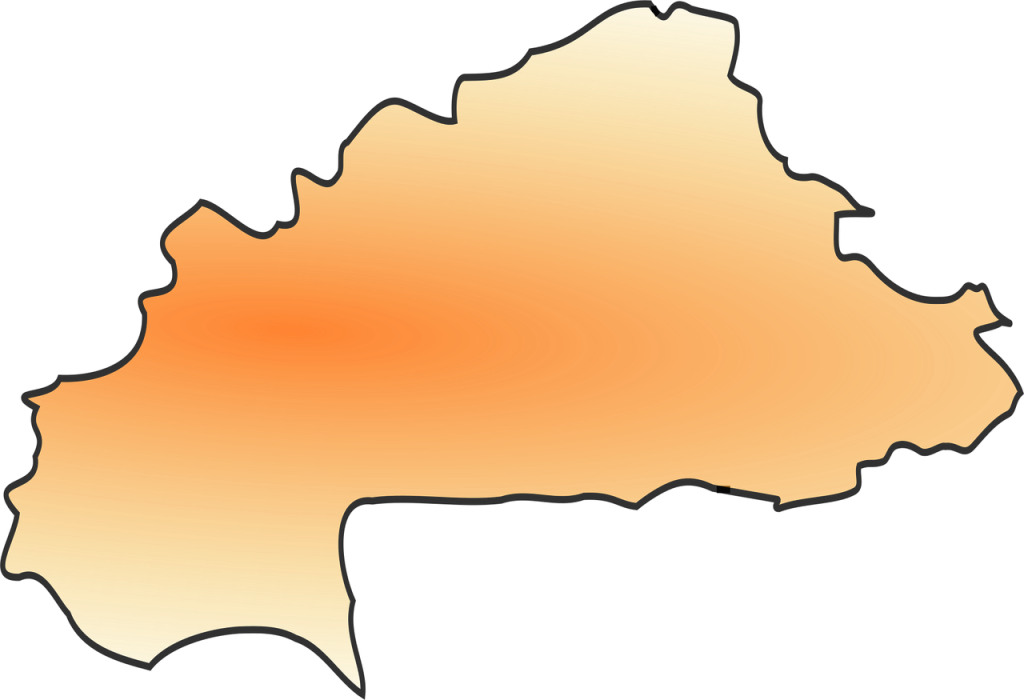
Burkina Faso, located in the heart of West Africa, is a country with rich and varied geographical contours. In 2026, understanding the geographical map of this landlocked nation becomes essential to grasp its territorial organization, its distinctive relief, as well as the importance of its regions and cities in the current social and economic context.
Physical geography and topography of Burkina Faso
Burkina Faso, with its 274,220 km², has a topography mainly characterized by plateaus and vast plains. The physical map highlights its moderate reliefs, which oscillate between the highlands of the southeast and the savannahs of the north. This country, integrated into the Sudano-Sahelian space, sees its hydrography marked by several seasonal rivers, essential to its agricultural activities and rural life.

Temporary wetlands and rivers, notably the Mouhoun (formerly Black Volta), play a crucial role in constituting a vital hydrographic network. Although the country does not have maritime access, its geographical positioning, far from Ivorian or Beninese ports, influences its commercial dynamics and its regional relations.
Regions and administrative divisions according to the current geographic map
The administrative map of Burkina Faso in 2026 reveals a division into thirteen territorial regions, each comprising several provinces, villages and towns. Ouagadougou, the capital, is not only the political center but also a booming economic hub. This regional configuration facilitates local management while emphasizing the ethnic and cultural diversity dispersed across the different areas.
This territorial network contributes to a better understanding of urban-rural disparities, with approximately 33% of the population living in urban areas compared to 67% in rural areas. Even if security challenges persist, particularly in the north-east of the country, this structure remains a strategic lever for adapted governance.
Borders and geopolitical issues in West Africa
Surrounded by Mali, Niger, Benin, Togo, Ghana and Ivory Coast, Burkina Faso shares sensitive borders which influence its socio-political climate. Since 2023, the country has been engaged in strengthened cooperation with its neighbors, through the Confederation of Sahel States, aimed at consolidating security in the face of jihadist threats. The geographic map also illustrates this border interconnection, highlighting strategic corridors.
In addition, the country has temporarily left some regional organizations, which changes its geopolitical outlook. These dynamics are inseparable from geographical understanding and therefore from the detailed map which depicts both the physical contours and the human issues.
Exploration of main cities through the geographical map
Besides Ouagadougou, other cities such as Bobo-Dioulasso, Koudougou and Banfora are essential urban centers which are illustrated on the detailed map. These cities are centers of economic and cultural activity, and sometimes of transit for cross-border trade. The local topography influences their development, particularly in areas where the relief offers advantages for agriculture or crafts.
To organize your trip and discover these regions rich in history and landscape, you can consult the best offers for your tickets and stays on specialized platforms such as best travel offers or Opodo plane tickets, in order to benefit from a stay optimized and accessible.
Integrate the geographical map into the understanding of Burkina Faso
The geographical map is a fundamental tool for penetrating the very essence of Burkina Faso, whether it is its relief or the richness of its hydrography. These elements are essential for researchers, decision-makers, as well as for travelers wishing to better understand the diversity of landscapes or to plan cultural and ecotourism circuits in this region of West Africa.
To deepen this discovery, modern geographical studies now integrate satellite data and urban plans which optimize the management of natural resources. These advances promote better knowledge of risk areas as well as local economic potential.
Perspectives and current uses of geographic maps in Burkina Faso
In 2026, the geographical map of Burkina Faso serves not only as an educational tool but also as a support for sustainable development initiatives. Local authorities are now using these maps to improve territorial planning, while tourism stakeholders are exploiting the historical and natural wealth visible through the maps to attract more visitors.
For those who wish to venture to Burkina Faso by combining security and cultural discoveries, do not hesitate to explore the cheap travel offers and promotions offered by sites like voyager malin or Expedia dream vacation. These resources provide a practical interface that makes it easier to organize your travels in West Africa.